Research Overview
In the Zhen lab, we investigate how neurons differentiate, develop synapses, and form neural circuits that enable motor behaviors. Using the C. elegans motor circuit as a model, we combine the classic genetics studies, optogenetics and electrophysiology to answer the following questions:
- How is the anatomic ensemble of the motor circuit regulated?
- How does the C. elegans motor circuit generate rhythmic movement pattern? (or: how does a worm manage to move like a worm?)
C. elegans is an excellent experimental system for these studies:
Its compact and fully sequenced genome, as well as the fast life cycle, allows for the application of powerful forward and reverse genetic tools;
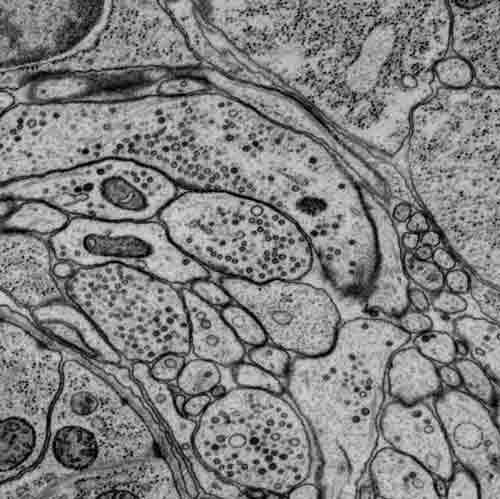
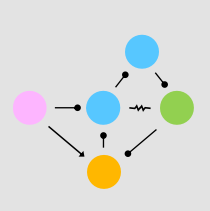
The connectivity of its simple nervous system has been deduced by EM reconstructions; the transparency of the animal, and the small number of neurons and synapses allow live imaging at single neuron and single synapse resolution;
Physiology tools - in vivo calcium imaging and intracellular recording, are now available, expanding the horizon of functional analyses of nervous system development and function;
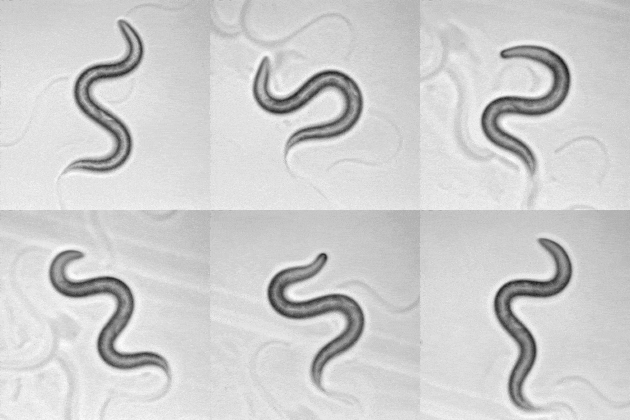
C. elegans exhibits a limited repertoire of motor behaviors that can be precisely quantified through automated tracking systems.
Our approaches:
1. We have developed an array of fluorescent markers that allow us to examine the axon and synapse morphology of C. elegans neurons. We perform genetic screens to identify C. elegans mutants that exhibit defective polarization and synapse morphology. Our subsequent molecular genetic characterization of these mutants leads to the identification of key regulators of neuronal development. See example pictures of these phenotypes
2. We have/are developing state-of-art movement tracking, electrophysiology, calcium imaging and optogenetics tools to interrogate the functional connectivity of the C. elegans neuromuscular system. Through these tools, we have demonstrated the presence of action potentials in C. elegans body wall muscles, and the role of interneurons in controlling the directionality of C. elegans’ movement. See movies of various C. elegans movement defects; the real-time calcium imaging of the motor circuit in behaving animals; the C. elegans action potentials
Ongoing projects:
1. How is neuronal polarity established?
Neurons are polarized cells that develop morphologically and functionally differentiated processes, called axons and dendrites, to receive, and reply information, respectively. We identified a Ser/Thr kinase, SAD-1, that plays an essential role to establish polarity in C. elegans neurons (Crump et al., 2001, Neuron). We further show that SAD-1 regulates neuronal polarity through its interaction with neurabin (NAB-1), a scaffold protein, to restrict the delivery of axonal components to axonal processes (Hung et al., 2007, Development; Kim et al., 2008, Neural Development; Kim et al., Development 2010).
An ongoing project is to use a genetic approach to identify upstream regulators of the SAD-1 kinase activity, as well as its downstream effectors. We are recruiting new graduate students or postdoctoral fellows to join the pursuit.
2. How is synapse development regulated?
Differentiated neurons establish synapses to communicate with each other. We identified a novel, neural-specific E3 ubiquitin ligase complex that is required for proper synapse growth: two novel proteins, RPM-1 and FSN-1, together with Cullin and SKP, form a novel SCF-like complex at the presynaptic termini. In the absence of components of this complex, neurons fail to make transitions between axon outgrowth and synapse differentiation (Zhen et al., Neuron 2000; Liao et al., Nature 2004; Po et al., Current Opinion in Neuroscience 2010).
We have now isolated new C. elegans mutants that exhibit defective synapse development, or premature synapse deterioration. Molecular cloning of these mutants will lead to the discovery of other key regulators of synapse development and neuronal aging. We are recruiting new graduate students or postdoctoral fellows to pursue the investigation of these exciting new genes.
3. How are neuronal excitability and communication regulated?
Active zones are specialized synaptic structures that mediate neurotransmitter release, thus synaptic communication. We developed a GFP::SYD-2 marker that allows direct visualization of active zones (Zhen and Jin, Nature 1999). We further isolated mutants with defective active zone marker morphology (Yeh et al., Journal of Neuroscience 2005; Stigloher et al. Journal of Neuroscience, 2011).
From these mutants, we cloned new regulators of the active zone morphology. Intriguingly, all of them encode ion channels that affect neuronal activity. One such regulator defines a new family of cation ion channel, NCA, which we showed to regulate neuronal excitability (Yeh et al., PLos Biology 2008; Bouhours et al. Molecular Brain 2011).
An ongoing project is to determine how these, and other ion channels regulate neuronal activity, and how neuronal activity affects active zone morphology.
4. How does the C. elegans motor circuit generate rhythmic locomotion?
Invertebrate nervous systems have long been critical for understanding nervous system operation from molecular, cellular and systems level analysis. Basic principles underlying the operation of rhythm generating circuits, such as the recurrent and reciprocal inhibition, and central pattern generators (CPG), were first described in the small motor circuits of invertebrates. Until recently, systems level analysis of rhythmic motor circuits has been limited to large invertebrates. However, optogenetics has opened the door to quantitative neurophysiology in small, transparent and genetically tractable model systems such as C. elegans.
The C. elegans motor circuit generates and sustains rhythmic forward or backward undulatory movement, but they exhibit a preference for forward movement. How each motor state is encoded in the motor circuit, as well as the switch between motor states, are poorly understood. We are probing these fundamental questions through automated behavioral analyses of C. elegans locomotion, in situ electrophysiology analyses on C. elegans neurons and muscles, and real-time motor circuitcalcium imaging in moving animals.
We employed the whole-cell current patch clamp preparations to examine the physiological properties of the motor system. We show that C. elegans body wall muscles fire calcium-driven action potentials that are potentiated by acetylcholine and cholinergic motoneuron inputs, and are inhibited by GABA and GABAergic motoneuron inputs. These studies provide direct evidence for a dual modulation model at the C. elegans neuromuscular junction to coordinate muscle contraction and relaxation (Liewald et al., Nature Method 2008; Gao and Zhen, PNAS 2011; see these cool action potentials).
We further developed an in vivo calcium imaging system that allows concurrent, high-resolution tracking of multiple calcium signals from the motor circuit in moving animals (Kawano, Po et al., Neuron 2011; see calcium imaging movies in live animals). With this system, we reveal that 1) the directionality of C. elegans’ movement is determined by an output imbalance between the forward and backward circuit; 2) C. elegans changes its directionality by alternating the output imbalance; 3) gap junctions function as current shunts to self-maintain the backward circuit at a low output state, establishing C. elegans’ inherent bias to execute forward motion.
With these tools, our goal is to uncover the motor circuit activity patterns that generate multiple motor behaviors (see movies of animals with various motor deficit that we are studying). We encourage Ph.D students and postdoctoral fellows who are interested in neurophysiology to join us on these exciting adventure.
|