


![]() | ![]() | ![]() |
Our research is directed at furthering the understanding of protein kinase regulation with a particular focus towards the underlying structural mechanism that imparts specificity to signaling function. We seek to uncover the structural basis for novel catalytic switching, substrate recognition and down-stream phosphoregulatory mechanisms. In addition, we are interested in uncovering the structure and function of new proteins and activities that impact protein kinase function. These efforts have recently led our lab into the area of ubiquitin directed proteolysis. Our long-term goal is to make use of what we learn about protein kinases and phosphoregulatory systems to develop drugs to treat human disease.
Below is a sampling of active projects in our laboratory:
RAF signaling
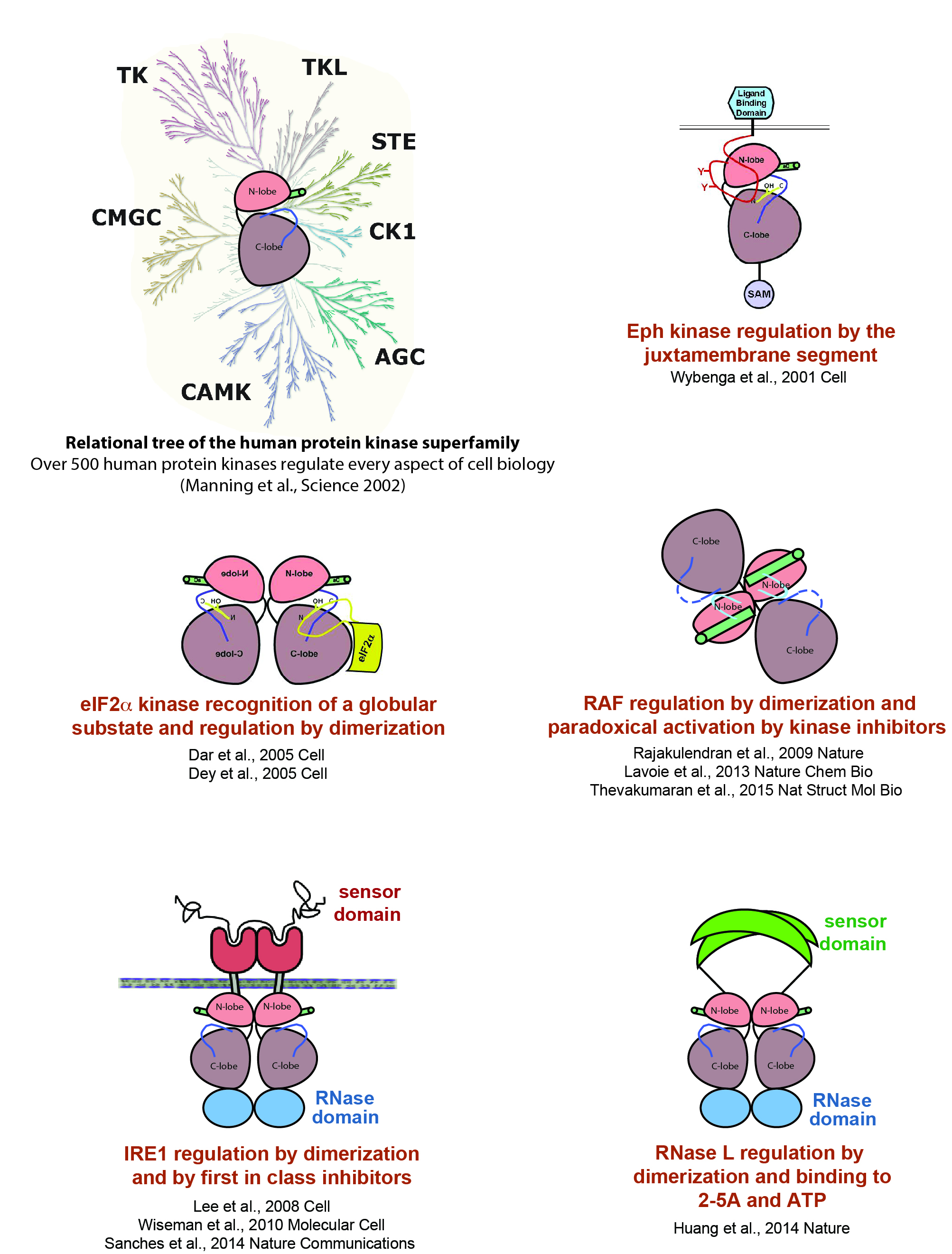
A dimerization-dependent mechanism drives RAF catalytic activation. The RAF family kinases are amongst the most prolific human oncogenes. Understanding the mechanisms that underlie RAF family function would facilitate approaches to RAF inhibition that would afford an effective tool against many cancers. In collaboration with Dr. Marc Therrien at the IRIC (Institute for Research in Immunology and Cancer, University of Montreal), we undertook a multifaceted approach utilizing structural biology, biochemistry and cell-based studies to elucidate the mechanism by which RAF kinases are activated. We discovered that the activation of the catalytic (kinase) domain of RAF kinases is controlled principally by an allosteric interaction between two kinase domains in a specific side-to-side dimer configuration. The acquisition of the side-to-side dimer configuration is essential for aberrant RAF signaling in cancers, suggesting future RAF inhibition strategies could be aimed at preventing dimer formation. RAF inhibition strategies aimed at disrupting the dimer would represent a major advance over current generation of RAF inhibitors – one that it would eliminate the unwanted off-target effects of ATP-competitive inhibitors, as well as circumventing the paradoxical activation of RAF that results upon treatment with certain ATP-competitive inhibitors.
The UPR sensor IRE1
Structure of the dual enzyme Ire1 reveals the basis for catalysis and regulation in nonconventional RNA splicing. Certain physiological conditions, such as high secretory load, lead to the build-up of harmful misfolded protein clusters in an intracellular compartment called the endoplasmic reticulum (ER); cells in this state are said to be experiencing ER stress. Cells have evolved an adaptive mechanism termed the Unfolded Protein Response (UPR) to detect and resolve ER stress. IRE1 functions as a key sensor and signal transducer of ER stress in all nucleated organisms. In response to ER stress, IRE1 activates a signaling protein called XBP1 that upregulates UPR genes to combat ER stress. IRE1 was initially recognized as a receptor protein kinase, which are enzymes that attach phosphate groups onto proteins such as signaling proteins to augment their function. IRE1 does not put phosphates on XBP1. Instead, to activate XBP1, IRE1 excises an internal segment (an intron) from messenger RNA (mRNA) coding for XBP1. How IRE1, previously known only as a receptor kinase, eliminates the ER stress responsive intron from XBP1 mRNA has been a mystery since this phenomenon was described more than a decade ago. To investigate the mechanism of IRE1 function, we determined the X-ray crystal structure of the cytosolic effector region of IRE1 protein from Baker's yeast. By studying this structure we gained new insight into the inner-workings of IRE1, which were subsequently confirmed using biochemical, biophysical and genetic approaches. We discovered that when IRE1 is activated by misfolded proteins, the effector regions of two IRE1 molecules attach together in a precise back-to-back arrangement. This arrangement composes a catalytic surface spanning the paired IRE1 molecules, which allows IRE1 to make incisions in XBP1 mRNA. We also discovered how the association of IRE1 effector regions is controlled by binding of a stimulatory molecule called ADP, which in turn is regulated by the ability of IRE1 to attach phosphates onto itself. Our findings provide a deeper understanding of how IRE1 communicates ER stress signals across the ER membrane. Our discoveries also illuminate potential avenues to modulate IRE1 function pharmacologically; interest in this area is gaining momentum given the emerging connection between IRE1 and numerous human diseases including cancer and diabetes.
Mechanism of action of the culin nedylation factor Dcn1 |
||